The Photometria Photography Center presents the group photography exhibition by Erkan ÇİÇEK, Gonca TÜRK, and Kübra ŞAHİN ÇEKEN
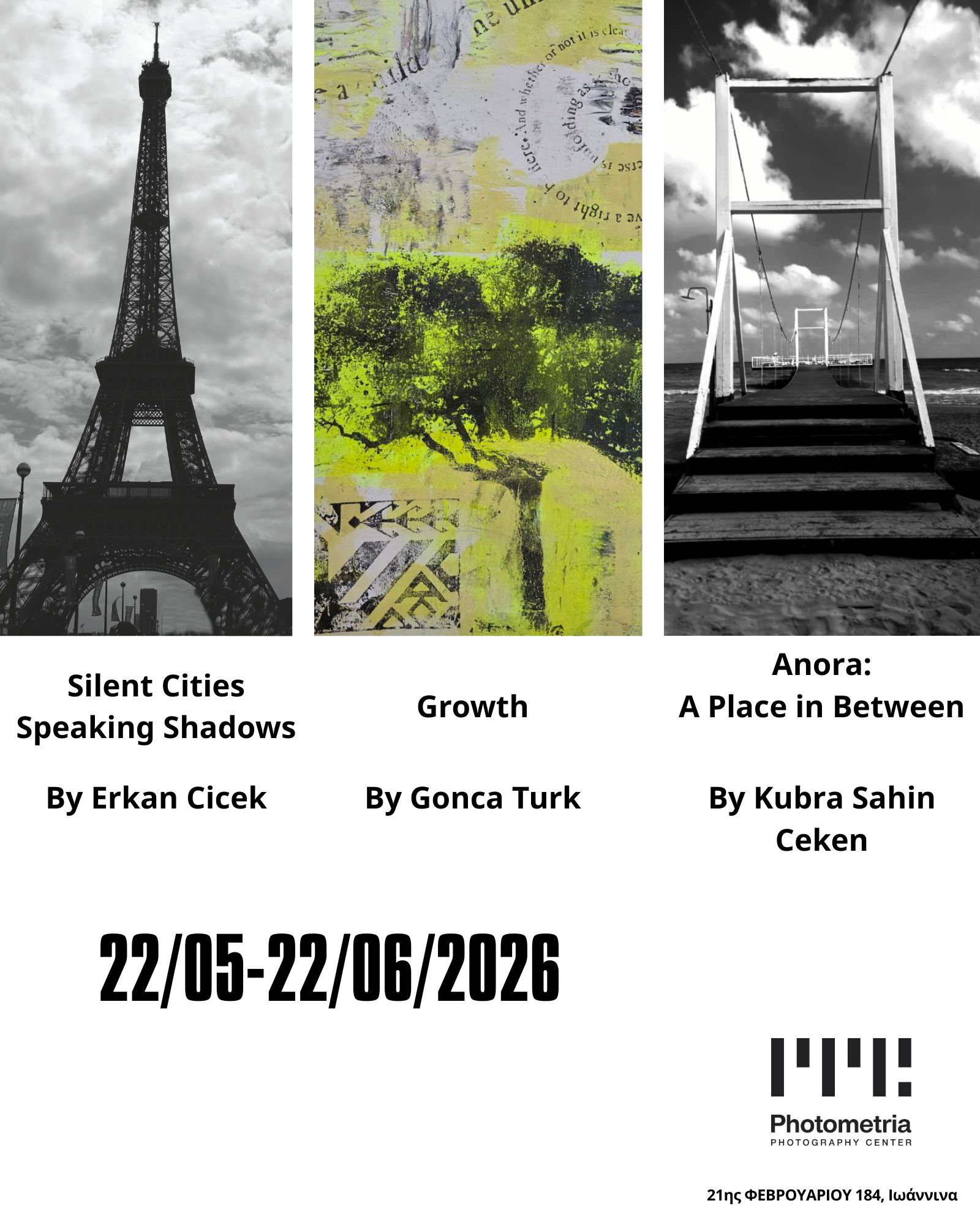
Exhibition Opening: Friday May 22, 2026, 20:00
Exhibition Duration: May 22 – June 22, 2026
Opening Hours: Thursday – Sunday, 17:00–21:00
Free admission
PHOTOMETRIA PHOTOGRAPHY CENTER
21is Fevrouariou 184, Ioannina 45221
T +30 26513 06361
Erkan ÇİÇEK
Silent Cities, Speaking Shadows
To understand a city is not merely to stand in its squares and observe; rather, it is to listen to the whispers exchanged among stones, shadows, and time.” Spaces are not inert masses composed solely of brick, iron, and concrete. They are living organisms endowed with their own language, bearing the accumulated traces of lived experiences, silent farewells, fleeting crowds, and centuries of memory. From the monumental towers that pierce the skyline of Paris to the Gothic domes of Amsterdam that seem to murmur to its canals, each structure constitutes a sentence within the collective memory of humanity. In this exhibition, Erkan Çiçek invites us not to engage with the familiar touristic postcards of cities, but to attend to the deeper “conversations” embedded within these spaces. Employing the camera not merely as a recording device but as an instrument of listening, the artist renders visible the silent cries and whispers of stone structures at the heart of Europe. The monochromatic and dramatic tonalities in the photographs strip these spaces of the chromatic excess and noise of everyday life, enabling structures to articulate their own purified language. Space comes into being through light and speaks through shadow. Whether in the monumental lines of the Louvre or the playful presence of Brussels’ Manneken Pis, the moment of exposure does not arrest time; rather, it reveals the ongoing dialogue between the past and the present of space. While light renders space visible, shadow imbues it with depth and enigma. Each frame in this exhibition constitutes a poetic interplay between light and shadow as they inscribe meaning onto space. This exhibition represents the rearticulation of these “stone languages,” gathered from diverse regions of Europe, within the ancient lands of Athens long regarded as the cradle of philosophy and democracy.
Gonca TÜRK
Growth
This exhibition explores the development and expansion of knowledge and science. In these works, the tree is presented as a symbol of knowledge emerging and growing from written forms. The texts are not intended solely for reading; rather, they function as visual elements that actively contribute to the formation of this growth. Within this body of work, the combination of the tree form and textual elements reflects the relationship between nature and knowledge. The tree operates as a living structure, while the texts resemble layers of information that accumulate over time. This process mirrors the formation of memory and the construction of meaning within the human mind. The use of Gelli plate printing (monotype) represents a deliberate response to the digital age and the rise of artificial intelligence. While digital images can be infinitely reproduced, each work in this collection is entirely unique and unrepeatable formed through physical touch, pressure, and unpredictable material interactions. These works also engage with contemporary identity, situated between the natural world and the digital realm. The combination of organic forms, textual elements, and layered textures reflects this dual condition. Ultimately, Growth emphasizes the value of uniqueness, physical experience, and continuous transformation in a world increasingly defined by repetition and reproduction.
Kübra ŞAHİN ÇEKEN
Anora: A Place In Between
“Anora,” a word from the Erzurum dialect meaning “right here,” suggests a form of spatiality that points without fixing. Rather than indicating a precise coordinate, it evokes orientation, transition, and a state of being on the threshold. The exhibition reconsiders this ambiguous notion of space through the image of the staircase.Beyond being a mere architectural element, the staircase represents, ontologically, a condition of “in-betweenness.” It belongs neither to a beginning nor to an end; its function is to establish continuity between two points. For this reason, the staircase is not a static space but a carrier of temporal and experiential flow. The 16 black-and-white photographs in the exhibition intensify this experience of transition through a visual language. Stripped of color, the surfaces sharpen the tension between light and shadow, while disrupting rather than stabilizing the sense of direction. The hierarchy between up and down becomes ambiguous; the viewer is confronted not with a spatial resolution, but with a perceptual indeterminacy.In this context, “Anora” is not a destination, but a condition—an interval that cannot be fixed or fully defined, yet can be experienced. The exhibition invites the viewer into this interval, into a process of meaning-making that resists certainty and is constantly deferred. Ultimately, “Anora: A Place In Between” approaches space not as a goal, but as a process. Rather than guiding the viewer, it suspends them—precisely in the state of “right here.”